
Markets Are Falling. We’re Finding Opportunities.
How we are approaching volatility, adding stocks, and thinking about risk in the current market

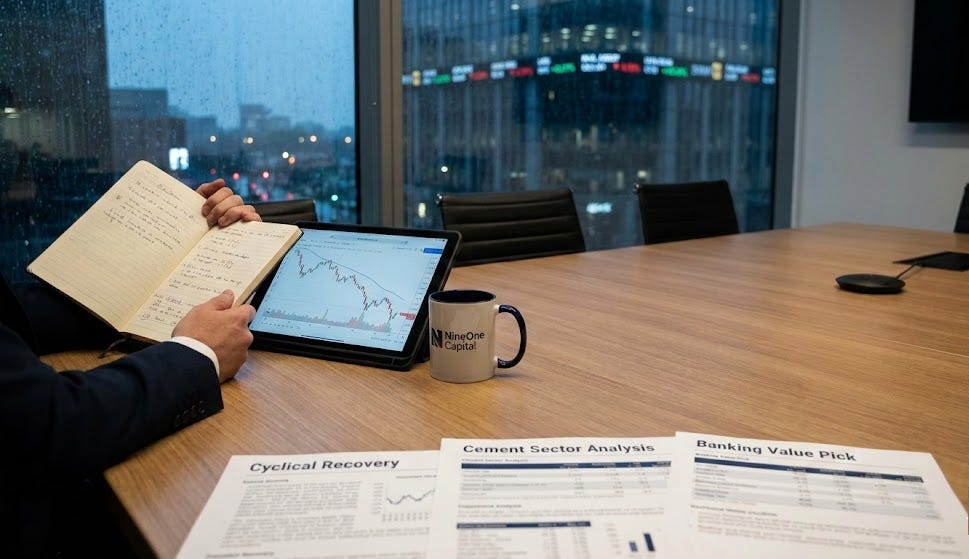
Over the past few weeks, markets have become visibly more volatile. Small and mid-cap stocks, in particular, have seen sharp corrections, often disconnected from near-term fundamentals. While we have come across many such phases over the last 15 years of investing, this kind of market environment can still feel unsettling for many investors.
This post is meant to explain:
What we are doing in this phase, particularly in the context of the three stock recommendations we have made recently, and how they reflect our broader thinking in volatile markets.
Why we are doing it
How we think about capital protection and decision-making during phases like this, where emotions often override logic.
Volatility itself is not the enemy, Poor decision-making during volatility is
Markets are structurally designed in a way that makes rational decision-making difficult during drawdowns. Every day, prices flash red. News headlines amplify fear. Social media rewards pessimism. In such an environment, even experienced investors begin to doubt their process. This is innate human nature.
Don Norman, in The Design of Everyday Things, explains how poorly designed systems lead even intelligent people to make repeated mistakes. Financial markets are a classic example of such a system - constant noise, instant feedback, and no clear signal of when to act.
Layer on top of that the work of Martin Seligman and Steven Maier on learned helplessness, which showed that when individuals feel a lack of control or understanding, they either freeze or make irrational decisions.
This is exactly what happens during market corrections.
People stop thinking in probabilities.
They stop evaluating businesses.
They start reacting to price alone.
Our job as investment managers is not just to pick good stocks. It is to prevent this psychological breakdown from happening.
That context is important before we explain what we have been doing over the last few weeks.
3 Things that we are doing in this phase
1. Increasing allocation to existing recommended stocks
we have selectively increased allocation. Not because we believe we have seen the bottom nor because we are trying to time the market, but because risk-reward has turned meaningfully in our favor across select businesses.
Markets can always fall further. That is never in question. What matters is this:
When valuation, business quality, and long-term earnings power align, waiting for the “perfect” price often becomes more dangerous than acting.
At current levels, across a few of our ideas, the probability of permanent capital loss has meaningfully reduced. That is the only condition under which we increase exposure.
2. Conducting an additional client call
We usually conduct quarterly calls after the result season concludes. This time, we are doing one earlier on the coming weekend. We are doing this because communication matters most when volatility rises. Over the last few weeks, we have been actively sharing our views with our clients on highly volatile days.
We do this because when investors are left without context, fear fills the gap. And fear leads to:
Selling at the wrong time
Freezing when opportunity appears
Underperforming despite owning good businesses
Our responsibility is not merely to pick good stocks. Our responsibility is to ensure clients benefit from those decisions. If a portfolio performs well but the client exits midway due to anxiety, we have failed regardless of returns.
That is why this call matters. It is meant to:
Address the ongoing volatility and directing thing towards long-term outcomes
Walk through portfolio positioning
Answer questions transparently
3. Three New Stock Additions Over the Last Month
Over the last month, we have added three new stocks to our recommendations, taking advantage of heightened volatility. Historically, we have had some of the best investments emerge which were made in phase similar to the present. Let us briefly explain the thinking, without getting into names.
The First: A Cyclical Business at Decade-Low Valuations
This company is currently trading at valuations last seen during:
The COVID panic in March-April 2020 period which is coupled with
a deep industry downturn
Due to severe distress in the industry, coupled with the increased investor concerns on the existing issues. Basically, much of what can go wrong already has and hence we are able to find this company at decadal low valuation.
In the report that we have released, we have presented multiple levers at the core business level and at corporate level that can materially improve earnings over the next two to three years, along with the historical cycle and valuation context among other things.
The Second: A Cheapest High Quality Cement Company
This is among the most efficient cement players in South India. A few key facts:
Limestone reserves sufficient for over 30 years at expanded capacity
Consistently among the highest EBITDA per tonne in the region, indicating it being the most efficient player
Currently trading at ~USD 27 per tonne EV, the lowest in the listed space
That disconnect between fundamentals and valuation is precisely what creates opportunity.
The Third: A Bank (Our First Above ₹3,000 Cr Market Cap Pick)
This is our first recommendation above our focused market cap category of below ₹3,000 Cr market cap.
Because the valuation is unusually compelling:
Not one of the cheapest but the cheapest banking stock in India (~0.7x FY26 price-to-book, ~5x FY26 earnings)
One of the lowest Net NPA % as on Dec 2025
ROE expected at ~15% in FY26 and ~17–18% in FY27
Stands to grow at strong double digits in the next 2-3 years, fully capitalised and no dilution is required
We do not need heroic assumptions here. Even moderate execution can lead to meaningful upside over the next 2–3 years. We also note that in the last two quarters, a couple of other small banks have gained valuations multiples corresponding to the improvement in the performance.
The Common Thread Across All Three Ideas
What links these investments is valuation discipline.
Equally important, none of these companies require fresh equity capital to grow. Like all our recommendations so far, these businesses are sufficiently funded or generate sufficient cash flows. Hence none of these are dependent on favorable market conditions to raise money. That significantly reduces risk during volatile phases, when access to capital often becomes both expensive and uncertain.
Across all three investments, the common characteristics are clear:
Downside is increasingly limited by fundamentals, not narratives
Valuations already discount pessimistic outcomes
Over a 2–3 year horizon, the probability of permanent capital loss appears very low
That last point is critical. We do not invest to predict market bottoms. We invest to avoid permanent loss of capital. As Mark Twain famously said:
“I am more concerned with the return of my capital than the return on my capital.”
When valuations, business quality, and balance sheet strength align, waiting endlessly for marginally lower prices often works against long-term compounding. In such situations, discipline means acting, not hesitating.
This is precisely the framework under which these three additions were made.
Closing thoughts
We do not know whether markets will fall another 5% or 10% from here, and we do not pretend to. What we do know, however, is that valuations in select pockets have already turned attractive, and many sound businesses are available at prices that are rarely seen outside periods of market stress. When viewed over a two to three year horizon, the risk–reward in these opportunities appears increasingly favorable.
Our approach remains unchanged. We focus first on protecting capital, then on deploying it when fear creates mispricing. Discipline, patience, and clarity of thought matter far more than short-term predictions. Equally important is communication, ensuring that clients are not left navigating uncertainty on their own, but are supported with context, reasoning, and transparency throughout the cycle.
We are not here to sound clever or to time markets perfectly. We are here to compound capital sensibly over time. And sometimes, that means leaning in precisely when it feels the most uncomfortable to do so. We will close this post with the below quote from one of our mentors whom we have learned a lot.
“Most wealth in markets is not created by brilliance, but by staying invested when it feels most uncomfortable.”
The approach outlined in this note, focusing on discipline, psychology, and long-term risk–reward rather than short-term market movements, reflects how we think about investing across cycles. For readers who would like to better understand our research framework, how we evaluate businesses during volatile phases, or how our advisory approach is structured around long-term capital preservation and compounding, you may write to us at gaurav.a@nineonecapital.in or fill in the form here (link).
Important Note and Disclaimer: This article is not a buy/sell recommendation. This note is shared only for the education purpose and in no way, it constitutes any buying or selling recommendation.
Were you sitting on cash or added funds to increase allocation to existing stocks ?